
Large Group Team Building Activities: Best Ideas for 100+ People
Planning a work event or team-building activity for a large group is incredibly rewarding, but it comes with a different set of rules. Anything over 50 people starts to feel “big”. Once you hit 100+ attendees, you’re not just planning a team activity, you’re running an event with moving parts, timing pressures and running a risk of people standing around wondering what’s going on.
What works for a team of 10 doesn’t scale neatly to 150. Add more people without changing the format, and you’ll get bottlenecks, confused instructions and pockets of disengaged participants checking their phones.
A simple way to think about it:
-
50–100 people: Manageable, but only if the activity is well structured
-
100–300 people: Needs clear systems for teams, rotations, facilitators
-
300+ people: You’re firmly in event territory (think multiple zones, tight scheduling and actual crowd control)
The most common mistake is treating a large group like a slightly bigger small group. It’s not. One facilitator, one space, one shared activity? That’s how you end up with half the room participating and the other half awkwardly waiting around.
The activities that actually work at this scale are designed differently. They:
-
Break the group into smaller teams
-
Run things simultaneously, not sequentially
-
Keep people moving and involved
Get that right, and a 150-person event feels smooth and surprisingly easy to manage. Get it wrong, and it feels like a queue.
Naturally, the rest of this guide focuses on how to get it right with large group team building activities and corporate events that are built to handle the numbers.
What Makes an Activity Work for 100+ People

Not all team building activities fail at scale, but the ones that do usually fall apart in predictable ways: too much waiting, unclear instructions or one person is doing the activity while everyone else watches.
Large group team building activities only work when they’re designed for volume from the start. That means structure without unnecessary improvisation.
Here’s what actually matters:
1. Team-based structure
Instead of running an activity for 100+ people, try running it for teams of 5 to 10 – just all at once. This keeps people involved and accountable. It also avoids situations like one loud person taking over while everyone else checks out.
2. Parallel, not sequential
If your activity relies on one group going at a time, it’s already broken. Scalable corporate events for large groups run multiple things simultaneously:
-
Teams completing challenges at the same time
-
Multiple stations running in parallel
-
Decentralised formats (e.g. city-based or app-led)
Less waiting, more doing.
3. Clear, simple instructions
If it takes 10 minutes to explain, there's a good chance you’ve already lost the room. At scale, instructions need to be short, repeatable (visually and verbally) and easy to follow without constant facilitator input.
Take our word for it: things unravel quickly once 100 people start asking questions at once.
4. Enough facilitators (and the right roles)
Don't try to get away with just one host and a microphone. You might also need:
-
Facilitators managing teams or zones
-
Someone handling timing, scoring, and issues
- Ushers to help guide people to and between areas
The bigger the group, the more this starts to feel like production, not just facilitation.
5. A space that matches the format
The venue isn’t just a backdrop – it determines whether the activity works. For large group team building activities, you need:
-
Room to spread out (or multiple zones)
-
Clear movement between areas
-
Backup options (especially for outdoor team building events)
Trying to squeeze 120 people into a space designed for 60 will break even the best-planned activity.
6. Built-In flow
Good large-scale activities have clarity and momentum. People know where they’re going, what they’re doing and what happens next.
No dead time, no confusion.
Bottom line
If an activity depends on things like one group going at a time, constant explanation from the host, or everyone watching the same thing, it won't hold up for 100+ people.
The formats that do work are structured, fast-moving and built to keep everyone involved at once, which is exactly what you need for large corporate events and team activities to feel organised, not chaotic.
Large Group Team Building Activities

Having planned countless team events for large groups, we don't mind saying we know what works and what doesn't. That's why we've collated this list of the best large team activities for 100+ people, including some Team Days favourites.
What these ideas have in common is that the format is doing most of the work. People are split into teams, activities run at the same time, there's a clear structure and minimal downtime.
That’s what makes these ideas reliable for large groups and corporate retreats: they handle scale and keep people engaged without that stop-start feel.
Outdoor & City-Based Challenges
Amazing Race
One of our most popular active team games. Teams fan out across the city, chasing clues, tackling challenges and trying to stay one step ahead of everyone else. It works at scale because the crowd disappears; instead of 150 people in one place, you’ve got small teams moving independently, all in the same race.
Live City Poll
Teams hit the streets with a set of questions or challenges that require interacting with the public (e.g. “find someone who’s lived here 20+ years” or “get three opinions on the best coffee nearby”). It’s light, social and scales easily because teams spread out and create their own interactions.
Urban Explorer
Less about racing, more about uncovering. Teams still move through the city, but the pace is steadier and the focus is on discovery. Good when you want engagement without turning it into a full-blown competition.
Community Cleanup
Swap competition for purpose. Teams spread out across a local area, each responsible for making a visible impact. It’s straightforward, scales easily, and people walk away feeling like they’ve done something useful.
Landmark Build Challenge
Teams are assigned a famous landmark, given basic materials (cardboard, tape, props) and tasked to recreate it in a public space within a time limit. It’s visual, a bit chaotic, and works well for large groups because everyone can be building at once.
Competitive & High-Energy Events
Survivor Challenge
Think a circuit of challenges where teams rotate through different stations – some physical, some mental, all designed to keep things moving. There’s always something happening, so no one’s stuck on the sidelines.
Minute to Win It
Short, sharp challenges that are over almost as soon as they start. It’s chaotic in a good way, with quick bursts of competition, constant turnover and just enough pressure to get people properly involved.
Mini Olympics
Multiple games running side by side, with teams rotating through. It’s familiar, easy to follow, scales naturally, and the more space you have, the more you can run at once. Just be sure you have the right group for this, as it may not be accessible and enjoyable to everyone.
Indoor & Conference-Friendly Activities
Game Show
A classic indoor team building format for a reason. Teams compete from their tables, with a professional host running multiple rounds, scoring and a clear structure throughout. It keeps a large room focused without feeling rigid, because people know what’s happening and when.
The Pitch
Teams are given a ridiculous product or concept and a short time to prepare a pitch. Presentations are judged on creativity, persuasion, humour – anything you like. Works well in conference settings and keeps the whole room engaged during pitches.
Panel + Breakout Discussions
If you'd prefer to focus on learning and knowledge exchange, consider building an event around an insightful panel discussion featuring guest speakers. Then, break it down into smaller group discussions or activities that give people a chance to actually contribute, rather than just listen.
That Bingo Party
Light, social and deliberately low-pressure. People can lean in or hang back and it still works, which is exactly what you want in a large mixed group.
Creative & Collaborative Activities
Team Building Masterpiece
Each team works on a piece of a larger artwork, without seeing the full picture until the end. It’s structured but creative, and the final reveal gives the whole group something tangible to look back on.
Hackathon
Give teams a problem and a deadline, then get out of the way. It’s focused, practical and scales well because every group is working independently before coming back together to present.
Build a Bike
Teams work through challenges to earn the parts, then put everything together for a good cause. There’s a clear goal, a bit of pressure and a strong finish when the bikes are handed over.
Build a Hamper
Similar idea, but more flexible and less mechanical. Teams collaborate, make decisions and contribute to something that’s ultimately shared or donated.
What Great Large Group Events Do Differently
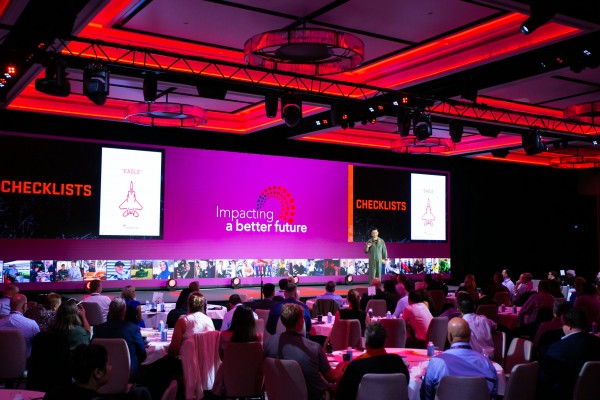
When a large group event works, you can feel it straight away. People are moving, talking and actually involved, not waiting to be told what’s next. It feels organised without being rigid, and there’s a steady sense of momentum from start to finish.
That doesn’t happen by accident. The best team building activities and corporate events for large groups tend to get a few key things right.
They make it easy to join in. No one wants to spend the first 15 minutes figuring out what’s going on. Strong events get people into the action quickly, with simple formats and clear starting points. You shouldn’t have to think too hard about how to participate – you just do.
They keep everyone part of something smaller. Even in a group of 150, people engage at the team level. Smaller groups create natural interaction, give everyone a role and stop the experience from feeling anonymous.
They build momentum early. The first 10 to 15 minutes matter more than most people realise. If the event starts well with quick wins, some energy and a bit of movement, the rest tends to follow.
They create a steady rhythm. Good events don’t spike and drop. There’s a clear sense of progression, whether that’s through challenges, rounds, stages or anything else. People always know they’re heading somewhere, which keeps attention up without forcing it.
They give people a reason to engage. Not everyone is motivated by the same thing. Some people respond to competition, others to collaboration, and the rest might just want a relaxed way to connect. The strongest formats allow for all of that, rather than forcing everyone into the same mode.
They finish with something to show for it. It might be a result, a winner, a shared outcome or even just a strong closing moment, but there’s a sense that the event built towards something. That’s what makes it feel complete, rather than just a series of activities.
Why this matters
Large group events are harder to get right, but when they do land, they’re far more impactful. Instead of feeling like a crowd, the group feels connected. Instead of drifting in and out, people stay engaged. And instead of just filling time, the event actually delivers something people remember. That’s the difference between a large event that leaves an impression and one that just happens.

Frequently Asked Questions: Large Group Team Building Activities & Corporate Events
These are the questions that usually come up once people move from “this sounds good” to actually planning something.
What are the best large group team building activities?
The best options are the ones designed to handle scale. Look for activities that:
- Split people into smaller teams
- Run multiple elements at the same time
- Keep people moving rather than waiting
Formats like city-based challenges, multi-station events, game shows and collaborative builds tend to work reliably for 100+ people.
How do you keep large groups engaged?
Engagement drops when people are waiting, confused, bored or not involved. To avoid that: keep instructions short and clear, use team-based formats so everyone has a role, run activities in parallel (not one at a time) and build in movement and momentum. If people know what they’re doing and can get started quickly, engagement takes care of itself.
What is the ideal team size for large group activities?
Usually 5 to 10 people per team. Smaller teams keep individuals involved, makes it easier to communicate, reduces the chance of people checking out and gives you flexibility around what activities you'd like to include. Once teams get too big, participation drops and a few people tend to take over.


Andrew is a Sydney-based writer who finds inspiration in people, purpose and bringing big ideas to life.
Let's do this
Enquire now
Add activities to your quote, or just tell us what you want to do.